Father's Day becomes more meaningful with age.
SINGHANIA SCHOOL
Father's Day becomes more meaningful with age.
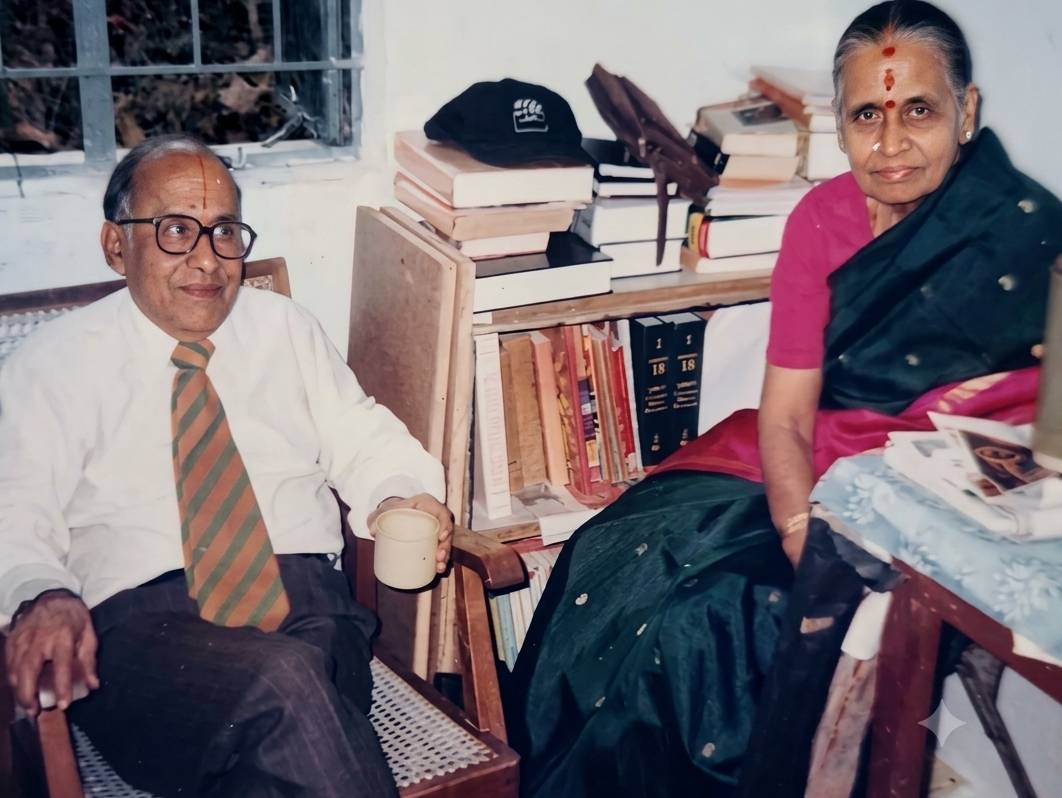
Often, we understand the depth of a father's influence only much later in life. Sometimes, only after he is gone. Even today, I am not sure I ever thanked my father enough for making me the person I am. My father was a defence scientist who headed a research lab from the age of thirty and built it from scratch. Yet, when I think of him today, I do not think first of his accomplishments. I think of the life lessons hidden in ordinary moments.
When I was a kid, my father drove us to school every morning at 7:30 a.m. and picked us up at 6:30 p.m. We were never rushed and never late. During those drives, we sang songs together. After school, while waiting for him, I played with friends inside the Naval Base where my school and his laboratory were located. Later, sitting under a tree near the security gate, I finished my homework, assignments, art projects, and craft work. More often than not, the security personnel helped me complete them.
We never complained about inconvenience because it never felt like one. At home, after an early dinner, evenings were filled with conversations. We spoke about school, work, challenges, expectations, and ideas. There was music, discussion, and appreciation of art. We were not isolated in our rooms. There was no concept of "me time," “my space,” “my friends” because life itself was shared. We grew up participating in one another's worlds.
I was fortunate. My father was remarkably progressive for his time. He encouraged his children to pursue careers of their own choosing. Perhaps his travels abroad for defence projects exposed him to different ways of thinking. Whatever the reason, he was often doing things decades before they became fashionable. The one thing that used to annoy me was that he never remembered my age, my class, or even sometimes my school correctly. He would introduce me to his scientist friends as a fifteen-year-old when I was twelve, or say I was in Standard V when I was actually in Grade VII.
When I protested, he would cheerfully admit that he did not remember. Then he would ask, "Does it make a difference? You as a person matter more." At the time, I found it exasperating. Today, I understand. He saw people, not labels. Character, not credentials. Human beings, not descriptions.
He was brilliant and wonderfully human. Many times, he would forget to tell my mother that he had invited colleagues home for a discussion that would naturally stretch into lunch. We would discover this only when guests arrived at the door. The household would instantly swing into action. Somehow, everything came together. Nobody complained. Everyone simply adapted because people mattered more than perfect planning.
Looking back, I realise that the greatest lessons of my childhood were never formally taught.
- I learnt simplicity from a man of extraordinary accomplishment who never felt the need to announce it.
- I learnt humility from someone who held power and position, yet listened carefully to the youngest voice in the room.
- I learnt vulnerability from a father who was never afraid of being imperfect.
- I learnt teamwork from watching a family quietly pull together when plans changed without warning.
- I learnt fairness, resilience and hard work not through lectures, but through everyday life.
Most of all, I learnt kindness and empathy from a father who never hesitated to help someone in need. Children should not grow up seeing their father only as the person who pays the bills, grants permissions, returns from official tours with gifts, or arrives home with suitcases full of goodies. They should see him everywhere in the small routines, taking everyday responsibilities , and having ordinary conversations. Children watch parents closely. It matters how you treat people , how you respond when things go wrong, because . That is where character reveals itself. The older I get, the more I realise that children do not need perfect parents. They need present parents. They need conversations more than gifts, examples more than advice, and values demonstrated more than values declared.
Long after a father grows old and his achievements fade into history, what remains is not what he bought for us. It is what he showed us.
- The way he treated people.
- The way he laughed.
- The way he worked.
- The way he responded when things didn’t go well.
- The way he lived
And if we are fortunate, those lessons become part of who we are. Today, I miss my father. But even more, I am grateful for him. Because his greatest achievement was not the laboratory he built, the positions he held, or the recognition he earned. His greatest achievement was the lives he quietly shaped, beginning with mine.