From 400 to 7,000 - Inside the School Raymond Built to Bring Its Workers' Families Home
EDUCATION
From 400 to 7,000 - Inside the School Raymond Built to Bring Its Workers' Families Home

A conversation with Dr. Revathi Srinivasan, Director and Group Dean of Singhania Group of Schools.
In 1969, a visionary industrialist did something unusual with an insurance cheque.
Gopal Krishna Singhania, then Chairman of Raymond, had lost his wife in a car accident in Toronto. The Government of Canada paid out one lakh rupees in insurance. He didn't keep it. He put all of it into building a school, on forested land next to his factory, in memory of his wife, Smt. Sulochanadevi.
The logic behind it wasn't sentimental alone. Singhania's factory workers wouldn't move their families to the area unless there was a good school to send their children to. So he built one, named it after his late wife, and appointed his own Senior President, Shri BK Kedia , to oversee the school as the de facto Principal simply because he trusted him best.
That school started with four classrooms and roughly 400 students. Today, it has 7,000, on the same 12.8-acre campus. This is the story of how Smt. Sulochanadevi Singhania got established, and what its faculty and staff led by the Principal and Director of two decades has built.
The Teacher Who Came in to Save One Class
Mrs. Revathi Srinivasan didn't set out to run Singhania School. She joined it as a Grade 10 English teacher, fresh off a stint in Tokyo, at a moment when the school desperately needed one. The previous Grade 10 teacher had left due to a personal problem, and the batch was headed into board exams.
"I told Mr Jani , the then Principal, that I was working on a UNESCO project," she recalls . His response: "That doesn't matter, you come, because we need a good teacher immediately."
She stayed.
What she built in that first classroom became the template for everything that followed: be a friendly teacher, but never a friend. Be warm without surrendering the boundary. Set standards that ask more of students than they believe they can give, and then teach them to rise to them. For her, that was always the point of education - not to make the path easy, but to make students capable of walking it.
Three years as Vice Principal followed, sharing responsibilities for academics and staff development. In 2007, she became Principal. By then, she had held almost every role the school had to offer: cultural coordinator, head of department, head of section and, most significantly, the person who built both the ISC stream and the IB Diploma Programme from the ground up.
The Growth Nobody Planned For
When Mrs. Srinivasan took charge, the school had around 3,500 students. Today, it is home to nearly 7,000. And she is candid about how that growth happened: there was no grand strategy to double the numbers.
"I didn't even realise, honestly, that we were touching 7,000. It just happened."
What was deliberate was the decision to stop depending on the parent company for the essentials. Early in her tenure, she moved the school away from its reliance on external water, electricity, and generator support- a conscious bet on self-sufficiency.
The path to that independence was steady rather than spectacular. Instead of one sweeping expansion, the school added capacity methodically, one class per section at a time.
The growth followed the need.
Eventually, when the school was receiving more admission requests than its 7,000-student capacity could accommodate, she looked closer to home - not for a bigger campus, but for another one. She started a second school to absorb the demand. And it grew to 10 schools across cities .

For her, scaling has never been about adding students first and figuring out the rest later. Her framework is simple, and deliberately ordered:
Train and align the teachers to the school's culture first; then build the infrastructure and calculate the cost of expansion.
"If we are clear about these, the numbers are not a problem. "Technology became another part of that equation. The school reduced teachers' administrative burden, giving them something more valuable than efficiency: TIME.
Time to read. Time to train. Time to reflect. Time to grow. The school embraced technology early, reducing any mundane tasks
What She Refused to Change
Some things, she believes, should not get diluted .
Not everything needs to become bigger, newer, or more expensive. There are no air-conditioned classrooms, by choice. The 750-square classrooms have windows on both sides, allowing for natural cross-ventilation.
"Our children are living in air-conditioned houses all the time, breathing the same thing in and out again. Let them breathe some fresh air."
It is a small decision that reveals a larger one: growth should create capacity, not excess.
The same thinking shapes the CLASSROOM. Children are not sorted into neat categories of ability or privilege. The classrooms are deliberately multi-ability and socially diverse, bringing together children from different academic, learning and socio-economic backgrounds. Inclusion is not treated as a special initiative; it is part of the everyday experience of school. But keeping a school's essence intact as it grows requires more than preserving its physical features. It requires knowing what must never become negotiable.
TEACHER ATTENTION is one. A larger school cannot become a place where children become numbers on a register, and teachers become managers . Growth has to be accompanied by structures that protect the quality of the relationship between teacher and child.

LEADERSHIP is another. A school cannot depend indefinitely on one person carrying its culture. The deeper test of scale is whether leaders can be developed at every level - people who understand not just the rules of the institution, but the reasons behind them. People who stand strongly by values that build the culture. Culture has to be passed on deliberately, or expansion slowly replaces it with whatever happens to be convenient.
CULTURE has to be passed on deliberately, or expansion slowly replaces it with whatever happens to be convenient.
There is also the important question of building the institution itself - creating a strong culture of academic excellence, research, innovation, and continuous professional learning. A successful institution is not built only through policies and structures; it grows through shared values, clear expectations, and consistent practices.
Every new teacher and every new leader should understand what the school stands for, where its boundaries lie, and which practices are essential rather than accidental.
ADMISSIONS matter too. Once demand begins to outstrip capacity, the pressure is to treat growth as the goal. But a school has to remain clear about why it wants to serve the community and how. The numbers should follow the purpose - not redefine it.
The same discipline applies to PARENTS. As a school grows, the parent community can become as influential as the student population. Setting expectations early - about partnership, behaviour, communication, and the school's educational philosophy - helps prevent the culture from being reshaped by the loudest voices.
And then there is STUDENT VOICE. The larger an institution becomes, the easier it is for decisions to be made for children rather than with them. Preserving opportunities for students to question, contribute, lead, and be heard keeps the school from becoming overly institutional. Ultimately, the challenge of scale is not infrastructure. Infrastructure can be built. Classrooms can be added. Systems can be digitised. Processes can be documented.
The harder question is:
What cannot be allowed to become diluted?
For her, the answer lies in the things that are hardest to measure - teacher quality, individual attention, inclusion, high expectations, intellectual curiosity, and the sense of belonging that makes a school feel like a community.
That is the real discipline of growth: knowing what to change, knowing what to improve, and having the courage to leave some things exactly as they are. No filmy music or dance in school programs. Every performance is scripted and choreographed by teachers and students together, often set to folk music, sometimes with teachers writing original poems that are then set to tune.
And the school's original principle of inclusion: children of Raymond's mill workers and children of its top officials sit in the same classrooms, with no visible distinction by economic background, a policy she says the school has held to from day one, long before "inclusion" became a common word in education.
The school has also held onto strong academic results. She says it has produced All India toppers for the past ten years, alongside a deliberate emphasis on sport, debate and music, not academics alone.
"You Can't Change People"
Asked about the biggest mistake she's learned from, her answer is immediate: assuming she could change people simply by wanting them to.
It took her nearly a decade in leadership to arrive at this.
"People don't change. They change when they think they want to change, not because you want them to," she says.
On building leadership under her, she describes a deliberately non-hierarchical, "circular" model - sharing ideas rather than issuing instructions, and pushing people into situations that force them to grow rather than waiting for a formal successor to emerge.
"Believe in the power of what people can deliver," is how she puts it.
She's equally clear that this isn't a one-year exercise: leadership, in her framing, is built through repeated small challenges over time, not a single training programme.
She's also candid that her own leadership lessons didn't come from her business degree. She credits her family for lessons in humility , compassion and determination, and just as often, the school's own support staff , students and their parents .
She recalls the school's maintenance staff finding quick fixes for event logistics, and students themselves flagging practical issues, like the wrong kind of mat for a gymnastics event, that she says she's learned to take seriously. She also checks in with students after events to find out what went wrong.
The Leadership of Building, Not Chasing

Her advice to principals begins with something that is often difficult to accept in education: schools take time to become sustainable institutions. In her experience, no school breaks even before its fourth or fifth year. For a principal, recognising that reality is important, not as an excuse, but as a basis for planning. The early years of a school are about building trust, establishing culture, understanding the community and earning a reputation. Financial sustainability, she believes, has to be approached with the same patience.
That patience also shapes her view of growth. She is clear that a principal should not become the school's salesperson.
"Never become a marketing person," she says. "Don't tell your teachers to bring in five admissions each. I think it's important for principals to maintain the dignity of the chair."
For her, growth should not come from turning teachers into admission agents or putting pressure on the school community to deliver numbers. It should come from the quality of the school's engagement with parents and students-and, over time, from the reputation that quality creates.
A principal's role is to build the institution, not to market it. That same conviction informs her view of competition. She cautions school leaders against constantly looking sideways at other schools or measuring their progress against another leader's achievements.
"I don't believe in the rat race, because if you go into a rat race, you remain the rat throughout your life."
The alternative is to stay focused on one's own journey: to look at where the school was last year, where it is today, and what needs to improve tomorrow. For a leader, that means defining success on one's own terms rather than allowing someone else's scoreboard to determine it. It also means accepting that the journey will include mistakes.
Her advice is not to be afraid of making them, but to have the courage to acknowledge them openly. Mistakes, in her view, are part of leadership; attempting to hide them only prevents an institution from learning from them. There is strength, rather than weakness, in a leader who can take responsibility and move forward. The same balance of empathy and firmness applies to parents.
Every parent walks into a school believing that their child is different, and, naturally, deserves individual consideration. But a school cannot function if every request becomes an exception.
"Every parent who walks in thinks it is only his child who's going to be in school... it's not possible," she says.
For her, this is ultimately part of the school's responsibility. Education is not about creating a world in which a child is always accommodated. It is about preparing children for a world that will not always accommodate them. That requires schools to listen and care, but it also requires them to establish boundaries and hold them.
Underlying all of these views is a larger belief: a school should develop its own character rather than constantly borrow someone else's.
That is why, when asked whether other schools should try to replicate the Singhania model, her answer is unequivocal:
"I think no school should copy from each other."
Instead, she offers a memorable metaphor.
"Spread your aroma like the coffee beans across your school. Don't bother about your coffee beans smelling in the neighboring school... I'm not going to get that cup of coffee anyway."
It is a fitting way to describe her philosophy of institutional leadership. Every school should have its own aroma, its own culture, values, personality, and way of educating children.
The goal is not to make your school look like the one next door, just as the goal is not to measure your success by another principal's achievements. Build patiently. Lead with dignity. Own your mistakes. Hold your ground. And, above all, build a school that smells unmistakably like itself.
That, perhaps, is the real leadership lesson:
The strongest institutions are not created by chasing what others have built, but by having the conviction to build something of your own.
She now oversees ten schools under the same group and says deliberately, none of them are run identically; each has its own teachers setting their own question papers and building their own culture. The only things held constant across all ten are the basic philosophy and culture the group was founded on.

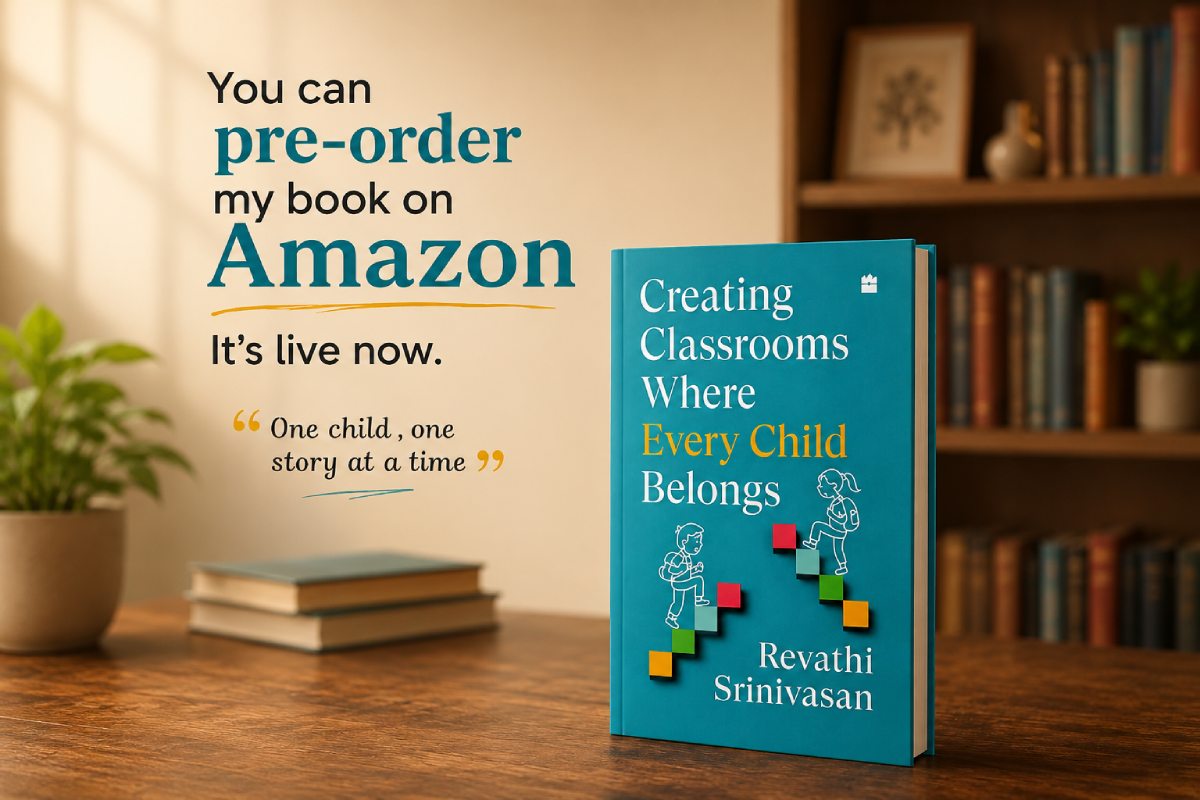
All her experiences have been woven into her book, Creating Classrooms Where Every Child Belongs, reflecting her belief that education is not only about academic achievement, but about creating spaces where every child feels valued, respected, heard, and empowered to learn. It brings together her experiences, reflections, and practices around building inclusive classrooms and institutions where both children and teachers can thrive. At its heart is the conviction that belonging is the foundation of meaningful learning, and that every school has the responsibility to create a culture where diversity is recognised as a strength, and every learner has the opportunity to flourish.
Mrs. Revathi Srinivasan has spent over 30 years at Singhania School, as Principal and Director of Singhania Schools